Showing posts with label Xerox. Show all posts

Wednesday, August 12, 2015

Xerox adopts NFL strategy to improve diversity

Xerox is taking a page from the NFL’s playbook, announcing on Tuesday that it will require that at least one minority and one woman be among the final applicant pool considered for any leadership hire in the United States.

The “Wilson Rule,” named after Xerox’s first CEO Joe Wilson, covers all management and executive-level positions, much like the “Rooney Rule” that requires one minority candidate be interviewed for every head coaching vacancy in the National Football League.
Xerox — led by Ursula Burns, the first female African-American CEO of a Fortune 500 company — announced the new initiative in conjunction with President Barack Obama and the White House’s first Demo Day, aimed at bringing greater diversity to the tech world.

The White House effort showcased work by more than 30 startup teams of women, minorities and young people — all underrepresented in entrepreneurship. The exhibits ranged from early-stage technology to consumer products. About 3 percent of America’s venture capital-backed startups are led by women; around 1 percent are led by African-Americans. About 4 percent of U.S.-based venture capital investors are women, according to the Whie House.

“Xerox has been in this game a very, very long time,” said Damika Arnold, global diversity and inclusion leader at Xerox. “What we have decided to do as a company is reinvigorate our efforts.”
Outside the U.S., Xerox would require that one woman be included in the final pool of qualified candidates. Not addressed — at least not yet — is whether and how to ensure the diversity of those making the hiring decisions. Arnold said the rule is still evolving. Wilson’s Rule will be implemented beginning in the fourth quarter of this year, Arnold said.

“Our first goal was really to figure out what type of rule would be beneficial to us,” she said. “This is where the real work begins, to figure out how this works in the real world.”
Xerox claims to stack up well nationally when it comes to diversity, with 28 percent of executive-level positions filled by women; 13 percent by minorities. Women account for 41 percent of managers globally, while minorities account for 24 percent of managers in the U.S., Damika said. The Wilson Rule evolved from a companywide project earlier this year, focused on the management and executive ranks, that looked at diversity in hiring. While numbers were not low from an industry standpoint, she said.

“We think people are hiring from small, non-diverse applicant pools,” she said. “Even though diversity numbers are good, comparative to the industry.”
Separately, USA TODAY reported that the National Venture Capital Association pledged concrete steps to increase diversity, from assessing and sharing company diversity, sharing model human resources policies and helping diversify the next generation of entrepreneurs and venture capitalists by participating in career programs that work with diverse populations.

BDSHARP@DemocratandChronicle.com
The Associated Press contributed to this report.

Tuesday, April 21, 2015

Xerox Wins $565M NY Medicaid Management Contract

Xerox Wins $565M NY Medicaid Management Contract

NORWALK, Conn. —
Xerox (NYSE: XRX) will work with the state of New York to update its Medicaid claims processing system to a next-generation technology platform that will help manage expanding Medicaid rolls. New York Medicaid currently serves over 6 million people.

Under a $564.9 million, five-year contract with the New York State Department of Health, Xerox will implement its Health Enterprise solution, a flexible, adaptable and analytical Medicaid Management Information System (MMIS). The system is one of the only platforms that can manage all aspects of contemporary Medicaid programs, including the new strategies in population health management, managed care, care coordination and other areas that are needed to meet Affordable Care Act objectives.

Given its very large and diverse Medicaid population, New York requires a modern technology platform to run the Medicaid program efficiently, while keeping up with changing state and federal requirements. Meeting consumer expectations for access is also key. For the first time, New York Medicaid members and providers will be able to access the system through a website optimized for mobile devices.

“Xerox is giving New York the flexibility to customize our Medicaid program so we can best serve both the people who rely on this system and the healthcare providers who are on the front lines of caring for them every day,” said New York State Medicaid Director Jason Helgerson. “We’ll rely on Xerox to offer a simple and straightforward experience for our service providers and our Medicaid population.”

Health Enterprise is Xerox’s newest solution to comprehensive Medicaid program management. It uses an already proven platform that allows for rapid design and development to meet New York’s specific needs. As Xerox continues to invest in innovating the Health Enterprise platform, New York will be able to easily adopt new system enhancements.
Health Enterprise offers New York and other states a variety of advantages:
  • Quicker updates: Traditional mainframe MMIS often require significant time and money to make system changes. Health Enterprise offers flexible program management, so administrators can quickly update program rules, implement new methods for improving member care and health outcomes, or adjust to new payment methodologies.
  • Modularity and interoperability: Functional modularity and data interoperability are key aspects of federal regulations for Medicaid Information Technology Architecture standards. With Health Enterprise, the Department of Health will be able to easily exchange data across modular components and with other state and commercial systems to work compatibly in a true information network.
  • Mobile access: Running on a user-friendly interface, Health Enterprise in New York is optimized for use on mobile devices. This will allow the state’s Medicaid clients to receive a variety of services, including access to their medical history, via Android and iOS devices.
  • Population health management: Analyzing the data of New York Medicaid members, the system will identify high-risk populations who might benefit from the state’s care management programs. Health Enterprise will also help the state monitor and manage healthcare delivery. New York health officials will use its case management tool to offer high-risk members resources that can help improve their health while reducing the overall cost of care.
“New York is currently navigating four major transitions – a significant Medicaid expansion, a shift to a managed care model, a shift to value-based payment, and a total technology platform transformation,” said Dave Hamilton, group president,Government Healthcare Solutions, Xerox. “With Health Enterprise we are well positioned to assist the state with all of these priorities – providing a platform that is flexible and intuitive so the state can best serve its Medicaid population and its evolving program goals.”
Xerox has more than 40 years of experience working with government health agencies to enhance the efficiency of programs that ensure the health of citizens. Currently being used in two states and being implemented in three others, Health Enterprise annually processes millions of claims and pays billions of dollars to thousands of doctors and hospitals on behalf of millions of Medicaid beneficiaries accurately and on time, saving states money and maximizing allowable federal financial participation.

To support the project, Xerox will add 400 jobs, including clerical staff, call center positions, healthcare professionals, and technical positions, in Albany and other New York locations. Xerox was founded in Rochester, where the company has more than 50 buildings and 600 acres of campus space that house its major global operations, manufacturing and research sectors. Xerox currently has approximately 10,000 employees in the state of New York.

About Xerox
Xerox is a global business services, technology and document management company helping organizations transform the way they manage their business processes and information. Headquartered in Norwalk, Conn., we have more than 140,000 Xerox employees and do business in more than 180 countries. Together, we provide business process servicesprinting equipment, hardware and software technology for managing information — from data to documents.
-XXX-

Wednesday, August 27, 2014

Xerox Is Not Just a Photocopier but Much More for An Investor

August 24, 2014 | About:

The Company is an expanded business methodology outsourcing organization overseeing transaction-escalated methodologies. Mass-travel ticketing frameworks, digital printing equipment, bundling printers, wide-design scanners and digital document management system are all part of Xerox's present product portfolio. Xerox still makes printers and individual printers, as well, however those products are presently a minority part of its business blend. The vast majority of Xerox's top line is currently determined by administrations. Xerox Corporation caters to small businesses and large global business to focus on their core business.

Quarterly results barely missing the estimates
Xerox (XRX) as of late reported second quarter results. It posted a consolidated revenue of $5.292 billion, sequential growth as against $5.110 billion in last quarter, but dipped by 2% year-over-year. The company reported EPS of $0.27 beating consensus estimate just by $0.1, yet net income came in at $270 million scarcely missing estimate by $20 million.
The second quarter showed advancement in execution on the company’s business technique. In the services business, revenue gains and margins are inclining great in commercial services, document outsourcing and universally. The revenue for the service business (57% of total revenues) increased 2% year over year to $2,992 million in the quarter. Service sector margins gains were partially muted by sustained weight in the government health care business including unplanned injury charges.
The Document Technology business continued to perform solid benefit through a taught and compelling methodology to operations. Revenues in the Document Technology segment dipped 6% year over year to $2,125 million (40% of total revenues) due to a fall in equipment sales and annuity revenues.

The service business is the segment where investors ought to be centered, as this section will counterbalance the decrease in document technology. Xerox's extreme arrangement is to move far from being document based organization to one that is a high-margin outsourcing organization.
As the company steps into the second half of the fiscal, its stays focused around enhancing the advancement and exploiting new opening that will shape to achieve higher growth plan.
Xerox has altogether pre dominated the market since the start of 2013, with an increase of 92%, but, it still has a lot of room to climb. The company still has great assessment metrics and strong profit prospects; its cost price to free cash flow ration of 8.32 is the most minimal of all S&P 500 tech stocks. Furthermore, the organization is persistent on returning large chunk of money to its shareholder through repurchase programs and dividends.

Money for investors from strong cash flow
Xerox has been stringent on its share repurchase programs, this enables it to attain a higher confidence among its investors. The company has been paying regular dividends, forward annual dividend yield is at 1.91% and the payout ratio is only 25%. The annual rate of dividend growth over the past three years was at 8.1%, and over the past five years was at 4.8%. The dividend yield has now fallen below 2%, but I would not be surprised to see the company raise its dividend some point.
The organization produced $325 million in cash flow from operations amid the second quarter and $611 million for the first half of fiscal 2014. In the second quarter, Xerox repurchased $204 million in stock and $479 million in the first half of the year. Xerox bought $696 million of its shares in 2013, in the wake of repurchasing $1.05 billion of its stock in 2012.

Journey ahead
Moving ahead, Xerox hopes to realign its plan of action to better adjust to the evolving market scenarios by stretching out indirect distribution channel and streamlining its supply chain and rich product portfolio. Xerox additionally plans to center all the more on vertical markets like healthcare. Furthermore, it is consolidating its Managed Print Services (MPS) with business process and IT outsourcing capacities and proceeding with its pushed for authority in Document Technology.
For the next quarter, Xerox anticipates GAAP earnings to be in range of $0.21 to $0.23 per share, while adjusted earnings are expected to be within $0.25 to $0.27. It further has allocated budget of $500 million for new acquisitions with prime focus on services, this in turn will always leverage the top line in future.

CONCLUSION
Since Xerox produces heaps of money and the payout proportion is low, there is a decent possibility that it will keep on raising its dividend. The company continued to deliver large sums of cash back to shareholders, during the first half of 2014. Given current valuation and profitability, I won’t be wrong to anticipate a high rate of returns in the year to come which make me conclude that Xerox can be a high yield stocks in a longer run.

Thursday, August 21, 2014

New Multi-Function Devices from Xerox Simplify Office Productivity, Offer Cost Effective and Secure Printing

New Multi-Function Devices from Xerox Simplify Office Productivity, Offer Cost Effective and Secure Printing 

MENAFN Press - 20/08/2014


(MENAFN Press) New multi-function printers (MFPs) from Xerox (NYSE: XRX) offer increased productivity, flexibility, and reliability to simplify how work gets done for any workplace.

The new Xerox WorkCentre 5945/5955 is designed with true 1200 x 1200 dpi that delivers superior image quality and print speeds up to 45/55 pages per minute. With output as fast as seven seconds and a 4,700 sheet paper capacity “ the device helps businesses get more work done, faster.

The Xerox devices allow users to scan, share or print documents, with increased flexibility. The devices have single pass duplex scanning, at up to 200 images per minute, and the customizable single touch scan feature makes it easy to quickly send scans to email, PC or the cloud “ with just a touch of a button.

Equipped with Xerox ConnectKey technology, users can print from the device of their choice, making printing quicker and easier too. Xerox Mobile Print and Apple AirPrint allow users to print securely, from almost any mobile device, to any MFP, regardless of brand.

In addition, the WorkCentre's uses the latest Xerox Emulation Aggregation (EA) Toner, which can be replaced by any user, providing less user intervention and more uptime “ so businesses can focus on the work that really matters.

To help businesses stay ahead of data breaches and other security threats, the WorkCentre 5945/5955 is integrated with McAfee technology “ ensuring that only authorized users have access to the device.


About Xerox
Since the invention of Xerography more than 75 years ago, the people of Xerox (NYSE: XRX) have helped businesses simplify the way work gets done. Today, we are the global leader in business process and document management, helping organizations of any size be more efficient so they can focus on their real business. Headquartered in Norwalk, Connecticut, we have more than 140,000 Xerox employees and do business in more than 180 countries, providing business services, printing equipment and software for commercial and government organizations. Learn more at www.xerox.com.

Thursday, April 10, 2014

Xerox Expands E-Discovery Managed Services with Acquisition of Smart Data

Xerox Corporation

Xerox Expands E-Discovery Managed Services with Acquisition of Smart Data

April 08, 2014

Acquisition Meets Increased Demand for E-Discovery Managed Services, Adds Experienced Team

NORWALK, Conn. - 


Xerox  (NYSE: XRX) today announced the acquisition of Smart Data Consultingto expand its e-discovery services and technology consulting capabilities designed for law firms and corporations. 
Smart Data provides hosted and on-site services using Viewpoint? software, the all-in-one e-discovery platform developed by Lateral Data (which was acquired by Xerox in 2012). The acquisition strengthens Xerox's e-discovery technical and process expertise by adding Smart Data's experienced leadership team and professionals while also expanding Xerox's managed review and collection capabilities.
"We're blending key capabilities with market demand with this acquisition," said Manoj Sharma, executive managing director of Xerox Litigation Services. "Smart Data's depth of expertise and customer-focused team will be a valuable addition both to Xerox and for our clients choosing to use Viewpoint to manage their e-discovery projects."
Viewpoint brings simplicity and affordability to e-discovery by enabling corporate legal departments and law firms to manage the entire e-discovery lifecycle using a single product. By using one product instead of many to manage e-discovery tasks - including collection, processing, early case assessment, analytics, assisted review, review and production - the e-discovery process is more efficient and cost-effective, and reduces risk.
Unlike other e-discovery software, all functionality is integrated and does not require third-party software or plug-ins. Viewpoint also offers advanced capabilities for filtering and processing data that is up to five times faster than other e-discovery software. This reduces costs related to processing, reviewing and hosting non-relevant data at the beginning of a legal matter.
Founded in New York in 2009 by Ed Robles and Imer Perezic, Smart Data is used worldwide by Fortune 500 corporations, mid-market companies and some of the world's largest law and boutique litigation firms. Smart Data's management team and 22 employees will continue to deploy, support and deliver Viewpoint managed services to its clients as part of Xerox Litigation Services.
"The synergies couldn't be clearer for our clients," said Ed Robles. "The company was first established to address the increasing demands of e-discovery and the key to successful and defensible litigation management is a delicate balance between strategy and technology."
Xerox offers a portfolio of solutions that can be flexibly deployed to help corporate legal departments and law firms solve their most pressing e-discovery challenges. Clients can opt for fully outsourced services using the OmniX® cloud-based review platform, CategoriX technology-assisted review service, on-premise e-discovery or managed services with Viewpoint, or a hybrid approach. Clients' use of Xerox's e-discovery technology can be supported by 24/7 professional services, consulting expertise and managed review.
About Xerox
Since the invention of Xerography more than 75 years ago, the people of Xerox have helped businesses simplify the way work gets done. Today, we are the global leader in business process and document management, helping organizations of any size be more efficient so they can focus on their real business. Headquartered in Norwalk, Conn., more than 140,000 Xerox employees serve clients in 160 countries, providing business services, and software for commercial and government organizations. Learn more at www.xerox.com.

Tuesday, January 28, 2014

Lexmark results beat estimates, shares jump


Tue Jan 28, 2014 8:51am EST
Jan 28 (Reuters) - Printer maker Lexmark International Inc reported better-than-expected quarterly results, helped by higher revenue from its managed print services and software businesses, sending its shares up 7 percent before the bell.
The company also forecast first-quarter adjusted earnings of 80-90 cents per share and revenue decline of 3-5 percent due to its exit from the inkjet printer business.
Analysts on average were expecting earnings of 85 cents per share, according to Thomson Reuters I/B/E/S.
Lexmark and larger rival Xerox Corp are working to grow outside their traditional printing business as cost-conscious companies print less and personal computing moves to tablets and smartphones.
Lexmark's revenue from its perceptive software business, which makes software to scan everything from spreadsheets to medical images, rose 70 percent to $72 million in the fourth quarter.
Revenue from managed print services, which allow companies to outsource their printing needs to a service provider, rose 22 percent in the quarter ended Dec. 31.
Total revenue rose 4 percent to $1.01 billion.
Net income rose to $94 million, or $1.48 per share, from $26.3 million, or 40 cents per share, a year earlier.
Excluding items, the company earned $1.18 per share.
Analysts on average had expected earnings of $1.09 per share on revenue of $929.5 million.
Xerox reported weaker-than-expected quarterly revenue last week as growth in its outsourcing services business, now its biggest revenue generator, stalled.
Shares of Lexington, Kentucky-based Lexmark were trading at $37.50 in premarket trading on Tuesday.

Friday, January 10, 2014

Xerox Corporation : Patent Issued for Print Smoothness on Clear Toner Enabled Systems


Xerox Corporation : Patent Issued for Print Smoothness on Clear Toner Enabled Systems

By a News Reporter-Staff News Editor at Journal of Engineering -- Xerox Corporation (Norwalk, CT) has been issued patent number 8619329, according to news reporting originating out of Alexandria, Virginia, by VerticalNews editors.

The patent's inventor is Lin, Guo-Yau (Fairport, NY).
This patent was filed on November 12, 2010 and was published online on December 31, 2013.
From the background information supplied by the inventors, news correspondents obtained the following quote: "When printing large constant color or slowly transitioning area, smoothness is one of the main concerns. Smoothness is usually driven by the xerographic characteristics, halftone dot design, and can also be dependent on media substrate type. Toner scatter, unstable halftone dots, substrate materials (e.g. loose paper fiber), and the like, can prevent regions of color transition in an output print from appearing smooth. Applying clear toner is known to improve the smoothness. However, applying it to the entire print can be an expensive proposition. This is especially true for print shops specializing in color document reproduction. As such, methods are needed which can automatically determine, based upon characteristics of the document itself, where clear toner is best applied such that regions of color transition appear smooth.
"Accordingly, what is needed in this art are systems and methods for determining an amount of clear toner to be added to a document image to improve smoothness of an output print in document reproduction devices capable of delivering an amount of clear toner to an image in the image path."

Supplementing the background information on this patent, VerticalNews reporters also obtained the inventor's summary information for this patent: "What is disclosed is a novel system and method for determining an amount of clear toner to be applied to a document image to improve smoothness in an output print rendered using a xerographic device capable of applying clear toner to the image in the image path. Using clear toner to improve smoothness advantageously enables a Gray Component Replacement (GCR) strategy in which more black can be used which can decrease the incremental cost for clear toner for print shops specializing in color document reproduction.

"In one example embodiment, the present method for determining where to apply clear toner to an image of a document to improve smoothness in an output print involves performing the following. First, an image of a document is received. The received document image is intended to be rendered on a document reproduction device capable of applying clear toner in the image path. The received document image is then analyzed to detect objects contained within the document. The objects can be, for example, constant color objects, smooth shading objects, and image objects. Document objects can be selected via a user interface of a computer workstation. Once the objects have been identified, an amount of halftone dot area coverage is determined for one or more regions of each object wherein color transitions occur. The determined amount of halftone dot area coverage for a given region is then compared to a predetermined threshold. If the amount of area coverage is below the predetermined threshold, the document reproduction device is signaled to apply clear toner to this region. Excessive clear toner can be removed via an ink-limiting operation. In other embodiments, a rate of color transition in the object region is determined and then compared to a predetermined transition threshold in a spatial domain. If the rate of color transition is below the transition threshold then the device is signaled to apply clear toner to the region.
"Many features and advantages of the above-described method will become readily apparent from the following detailed description and accompanying drawings."

Keywords for this news article include: Xerox Corporation.
Our reports deliver fact-based news of research and discoveries from around the world. Copyright 2014, NewsRx LLC
(c) 2014 Journal of Engineering via VerticalNews.com

Wednesday, November 20, 2013

Xerox Unveils Future Plans

Xerox Corporation (XRX - Analyst Report) recently offered an overview of its long-term strategic plans to increase shareholder value through an optimum mix of margin expansion and growth in services, focus on vertical markets and innovative technology and services. The news boosted investor sentiment as the shares gained 4% to close at $10.69 on Nov 12.

The Key Initiatives

In order to better adapt to the evolving market trends, Xerox has continually realigned its business model by expanding indirect distribution channel and streamlining its supply chain and product portfolio. Going forward, the company expects to increase revenues from the Services segment to 66% of total revenue by 2017 from 56% at present.

To achieve this objective, Xerox is focusing more on vertical markets like healthcare. The company has already begun to reap huge benefits from Medicaid Management Information System (MMIS) through the successful implementation and CMS (Centers for Medicare and Medicaid Services) Certification in 31 state Medicaid programs.
In addition, proprietary software developed by its subsidiary PARC has gained wide acceptance in the industry to combat fraud, waste and abuse in healthcare applications. Xerox has also launched health insurance exchanges in Nevada, Kentucky and other states to further strengthen its position in the healthcare services market.

In tune with the increased demand for connectivity and mobility, Xerox is integrating its market-leading Managed Print Services (MPS) with its business process and IT outsourcing capabilities. MPS enables clients to gain visibility and control of printing to save money, improve productivity, boost environmental sustainability and document security. The integration will automate workflow with technology and consulting services to help clients meet the requirements of mobile workforce. 

At the same time, Xerox is continuing its thrust for leadership in Document Technology with innovative products in order to meet the demands of customized communications in digital printing. These include waterless and inkjet-based solutions that enable print providers to deliver tailor-made services.

Fiscal Outlook

Xerox also provided its initial guidance for 2014 and reiterated its guidance for full year 2013. GAAP earnings for 2014 are expected to be in the range of 93 cents to 99 cents and adjusted earnings are expected between $1.10 and $1.16. The company expects operating cash flow to range from $1.8 billion to $2.0 billion in 2014.

Xerox increased its authorization for share repurchases by $500 million to bring the tally to approximately $1.5 billion. The company anticipates spending up to $500 million on acquisitions and $300 million on dividends in 2014.

Headquartered in Norwalk, CT, Xerox is a leader in the development, manufacture, marketing, servicing and financing of document equipment across the world. The company also provides extensive leading-edge document technology, services, software and genuine Xerox supplies for graphic communication and office printing environments of any size.

Thursday, May 30, 2013

Managed Print Services: From Big Paper to Big Data

Managed Print Services: From Big Paper to Big Data

Louella Fernandes By: Louella Fernandes, Principal Analyst, Quocirca
Published: 30th May 2013
Copyright Quocirca © 2013
Logo for Quocirca
Paper-based information is not often thought about in today's Big Data picture, which tends to focus on the proliferation of unstructured data from sources such as blogs, social media and video that is growing at exponential rates compared to traditional enterprise data. Yet paper documents are an important part of corporate business operations, often containing valuable information that must be captured, stored, organised and analysed.

Despite all the talk of the paperless office, organisations still rely heavily on paper documents. Every day businesses receive and print thousands of paper documents, mail, email and faxes that need to be captured and transformed for entry into business processes. Whilst some businesses have transitioned to electronic forms and transactions, many mission-critical business processes—such as billing, claims-processing and accounts-payable—are paper based. This reliance on paper is costly and inefficient and paper documents can be a huge liability.

As organisations try to reduce costs, improve process efficiency and establish compliance with various government legislation and industry regulations (e.g. PCI DSS, SOX, HIPAA, Data Protection Act), digitising paper documents through document capture is an important first step in business process automation. Document capture solutions are designed to remove the bottleneck paper creates at the onset of many business processes today.

When captured at the point of origination, paper documents can be directly integrated into business-critical processes. The full capture process includes scanning, data extraction from scanned images, document classification and sharing of content across electronic content management (ECM) systems. Documents become more accessible and easier to find, distribute and track. This increases productivity and streamlines processes, while supporting record retention, document security, and privacy requirements. Consequently, paper documents become part of the wider big data picture, enabling organisations to extract value from information to support faster decision making, for instance through business intelligence or big data analytics.
However, the challenge of document capture and processing can be daunting for many businesses, requiring specialist skills and resources. Despite the clear benefits of integrating all types of information into business processes and eliminating paper from these processes, employee attitudes and existing departmental systems can make it difficult to know where to start. Most organisations are resource constrained today, so many turn to outsourcing providers in order to focus on their core business.

The benefits of using an outsourced service include improved customer service, reduced business costs, compliance and greater efficiency. Outsourced services allow for easy scalability and can minimise infrastructure costs and disruption. One area where such business process automation is becoming more prevalent is in the managed print services (MPS) market. MPS is a proven approach to reducing printing costs by optimisating complex printer fleets, and deploying tools and technologies to minimise wasteful printing. As businesses move to next generation MPS engagements and are looking for further cost and efficiency improvements, many are working with their MPS providers to digitise paper workflows. With many organisations having already invested in multi-function printers (MFPs), working with MPS providers enables them to leverage these devices as sophisticated document capture and processing hubs.
Although many MPS providers are now competing in the wider and highly competitive BPO market, providers such as HP, Lexmark, Ricoh and Xerox have mature industry-specific services to automate manual processes such as electronic invoicing, mortgage application processing and health records management. With the core MPS services becoming commoditised, such business process services (BPS) are becoming key to differentiation amongst leading players in the MPS market.

Whilst big data and MPS may not have immediately obvious connections, many MPS engagements are advancing beyond the realm of device consolidation to encompass business process improvement. By accelerating the transition to digital workflows, paper based information becomes better integrated with enterprise data enabling organisations to extract business value from all data—both paper and digital.
Read Quocirca's MPS 2013 Report at http://www.quocirca.com/reports/835/managed-print-services-landscape-2013

Tuesday, May 28, 2013

Xerox worldwide market leader in managed print services for fourth consecutive year

Quocirca report names Xerox worldwide market leader in managed print services for fourth consecutive year

Xerox earned the top position in worldwide managed print services (MPS) for the fourth consecutive year, according to a new report by analyst research group, Quocirca. The report cites Xerox’s lead due to continued expansion and investment in its MPS platform and the unrivalled geographical depth, breadth and consistency of its offering in an increasingly competitive marketplace.

“Xerox excels in its broad coverage of enterprise offerings across office, mobile, production and offsite commercial environments,” said Louella Fernandes, principal analyst, Quocirca. “Xerox continues to make differentiating investments for the marketplace with new assessment and reporting tools that provide customers with predictive analytics to simplify their print environments, and use the data to further cost savings and productivity benefits.”

The report, which provides an independent evaluation of providers, shows a mature market with three quarters of very large enterprises (more than 10 000 employees) and 41% of mid-market organisations with MPS in place for more than three years. Recognising that many organisations are now entering their second or even third MPS contracts and looking to co-innovate with a provider, the report acknowledges Xerox’s strong heritage in MPS and commends its ability to adapt and extend offerings to address the changing needs of its customers.

“Xerox continues to expand the value of MPS by bringing customers new services and solutions for accessing data and content,” said Mike Feldman, senior vice-president, Xerox Global Document Outsourcing and Managed Print Services. “We’re setting the bar higher by taking what we learn from the print environment and building it into content management and business process automation strategies – so customers also benefit from ways to work smarter and speed time to revenue.”

As the worldwide market leader in MPS, Xerox is working with businesses of all sizes to simplify the way work gets done – so employees spend less time managing documents, and more time focused on their core business. Xerox integrates MPS into the IT infrastructure to help intelligently organise information – from both paper and electronic sources.

In addition to the Quocirca recognition, Xerox earned the top spot in all major analyst reports published on MPS in 2012, including being named worldwide market share leader [1] and positioned by Gartner in the Leaders' Quadrant in the 2011 Magic Quadrant for Managed Print Services Worldwide [2], and recognised as a leader in IDC’s Managed Print Services and Basic Print Services 2012-2015 Forecast and Analysis report [3] and 2011 MPS MarketScape report [4]. Additionally, Xerox was positioned as a leader in The Forrester Wave TM MPS 2012 report [5].


Wednesday, May 22, 2013

Xerox Annual Meeting of Shareholders: Chairman Details Solid Financial Position, Services-led Growth

Xerox Annual Meeting of Shareholders: Chairman Details Solid Financial Position, Services-led Growth

 
NORWALK, Conn., May 21, 2013 – At its annual meeting of shareholders held here today, Ursula Burns, chairman and CEO of Xerox (NYSE:XRX), highlighted the company’s solid financial position, progress in evolving to a services-led, technology-driven company and the steps Xerox is taking to capitalize on growth opportunities.

In her address to shareholders, Burns reflected on the last year and said, “2012 was a year of alignment: aligning costs with a services-focused business model, aligning investments with key priorities, aligning our diverse portfolio with market opportunities and aligning operations to address these opportunities. We did this through a customer-centric approach that took full advantage of our brand, innovation and global scale.
“With services now representing 55 percent of our total revenue and growing to two-thirds by 2017, we believe this is a good time to keep your eye on Xerox,” added Burns. “Through services-led growth, profitable leadership in document technology, our cash-generating annuity-based business model and earnings expansion, we have the financial strength to invest in building value for Xerox and for our stakeholders.”

She noted that despite economic headwinds, Xerox delivered solid results in 2012, including
  • Adjusted earnings per share of $1.03
  • $22.4 billion of full-year revenue
  • Operating cash flow of $2.6 billion
  • Adjusted net income of $1.4 billion
  • $1.1 billion in share repurchase and $255 million in dividends
The company recently increased its quarterly dividend by 35 percent and expects to repurchase at least $400 million in shares this year.
Also at the annual meeting, shareholders elected by an majority vote 10 members of the Xerox board of directors: Glenn A. Britt, Ursula M. Burns, Richard J. Harrington, William Curt Hunter, Robert J. Keegan, Robert A. McDonald, Charles Prince, Ann N. Reese, Sara Martinez Tucker and Mary Agnes Wilderotter.
Additionally, shareholders ratified the selection of PricewaterhouseCoopers LLP as the company’s independent registered public accounting firm for 2013; approved, on an advisory basis, the 2012 compensation of Xerox’s named executive officers; and approved an amendment and restatement of the company’s 2004 equity compensation plan for non-employee directors.
 

Tuesday, April 23, 2013

Xerox's technology business continues to struggle

An iffy economy and a new feature on some of its multifunction printers drove down sales for Xerox Corp. in the first quarter of 2013.

The Connecticut-based printing and business process outsourcing company announced its latest quarterly financial results Tuesday. And for the three months ending March 31, the Rochester area’s largest publicly traded employer saw its revenues — at $5.36 billion — down 3 percent from the same quarter a year earlier. While Xerox’s BPO services continue to grow — up 4 percent and now accounting for 55 percent of the company’s income — the technology side of the house is struggling more.


In a statement, CEO Ursula Burns said the technology business — the umbrella under which sits everything from office equipment to big digital printing presses, as well as the business of supplying and servicing them — was hampered in part by Xerox in February announcing its new ConnectKey software system for multifunction printers. Those printers, however, did not begin shipping until the second quarter. Equipment sales were down 11 percent during the quarter.


“We’re continuing to shift our business model to adapt to market trends by expanding indirect distribution and streamlining our supply chain and product portfolio,” Burns said. “These changes, along with implementing broader operational improvements across the company, will result in increased margins that will help us scale profitable revenue in services while maintaining strong market share in document technology.”
After expenses, Xerox had profits of $296 million or 23 cents per share, compared with $269 million or 19 cents per share a year earlier.


Xerox’s sales fell slightly short of Wall Street expectations, but exceeded them on profits. Analysts surveyed by Bloomberg had expected, on average, revenues of $5.49 billion and profits of about $254 million or roughly 20 cents per share.


Business services have been an ascendent part of Xerox’s operations since 2010, when it bought BPO company ACS. Since then, while Xerox’s technology business has been stagnant or declining, services have grown to now represent the majority of money the company takes in. That continues to raise questions about the fate of local Xerox operations, particularly the Webster manufacturing campus where the company makes high-end digital presses and toner. At the end of 2012, Xerox employed 5,800 locally.


Citing the economy, Xerox in October said it planned roughly $100 million worth of restructuring — which typically translates into layoffs — to get costs down. And Xerox said Tuesday it expects to spend about $35 million between now and the end of June on further restructuring. Worldwide, Xerox employs about 143,200 — down 4,400 from just three months earlier as the company goes through some restructuring.
Xerox spokeswoman Karen Arena said she did not have specific information on the planned second-quarter restructuring and how many jobs might be affected, but that “we’re taking the appropriate actions to better adjust our cost base for market realities.”
“It was a slow start in document technology,” Arena said.

Friday, March 29, 2013

Domtar acquires Xerox North America paper business

Domtar acquires Xerox North America paper business

By David Ward, San Diego Wednesday, 27 March 2013

Montreal-based Domtar has signed a deal to acquire Xerox's paper and print media products in North America, though the Xerox brand will continue on both coated and uncoated paper for office and commercial printing.

Domtar spokesman Nicholas Estrela told PrintWeek that Xerox had essentially been operating as a paper reseller, adding: "They were basically purchasing about 200,000 tons of paper, mostly uncoated free sheet - which is what we make - from Domtar and other manufacturers. In Canada we had essentially 100% of their business."

Estrela added that Domtar will honor the suppliers agreements Xerox has in place in the US for the time being. "Short-term it's going to be business as usual," he continued.

"We're going to continue to supply them Domtar paper in Canada. In the US we'll continue with some of the supply agreements with the other manufacturers, but over time we'll bring some of that tonnage into our system internally."

Though Xerox does not have any paper manufacturing capability of its own, its brand is very well thought of in both the office and commercial printing paper space.

"We'll continue to make that paper; we're just taking over another step in the process," Estrela said, adding Domtar will be picking up some Xerox employees in the US as part of the agreement.

Estrela emphasized there will be no change in Xerox paper pricing or supplies, noting: "About the only thing that could change is maybe a phone number or contact information. But we will be able to start building relationships with some of the 1,500 paper clients they have, so it's a win-win for both sides."

Though it is getting out of the paper reseller business, Xerox said it will continue to manufacture, sell and support consumables such as toner and ink.

In a statement announcing the deal, Xerox Senior VP-Global Paper and Supplies Frank Edmonds said: "As Xerox broadens its business to focus more on services and innovative document technology, we saw an opportunity for our paper business clients to be better served by a leader in the industry.

"Xerox benefits through a trademark licensing agreement with Domtar; Domtar adds a well-regarded brand to its portfolio; and our respective clients get a simplified, ‘one-stop’ experience through Domtar’s extensive offerings and distribution network."

Tuesday, March 19, 2013

Global Imaging to Implement Digital Gateway’s e-automate™ System


March 18, 2013 - Provo, Utah
Global Imaging to Implement Digital Gateway’s e-automate™ System
Provo, Utah— March 18, 2013: Digital Gateway, Inc., the leader in dealer management solutions for the independent dealer community, today announced that Global Imaging Systems, Inc. (GIS) will be implementing Digital Gateway’s e-automate™ dealer management system throughout its facilities. GIS is a leading provider of business technology solutions and one of the largest in the United States. GIS has approximately 200 offices operating across 38 states and the District of Columbia.

“We are excited to have Global Imaging Systems make the move to e-automate,” said Laryssa Alexander, President of Digital Gateway. “Leveraging the strength and efficiencies of Digital Gateway’s solution further enables GIS to continue its impressive growth. The synergies we have between our highly experienced staff at both OMD and Digital Gateway will enable GIS to transition its locations to the eautomate system quickly with minimal business disruption. Digital Gateway continues to prove its ability to scale with our valued customers as they grow from start-ups through mid-sized dealerships to large, nation-wide operations.” “e-automate is a great fit for GIS,” said Don North, Vice President of Information Technology for GIS.
“Upgrading to the e-automate dealer management system will allow us to modernize our ERP platform, realize process efficiencies and, most importantly, enable our businesses to provide world-class service for our customers”.

e-automate is a leading enterprise resource planning (ERP) solution providing total integration and automation from sales through service. It is specifically designed for service contract-centric organizations of all sizes and complexities. The e-automate system improves processes that save time, resources and money. With more than 20,000 direct and third party users, 35 partner integrations, tens of millions of data transactions per year coursing through its partner integration network, and a constantly evolving product suite, e-automate provides the comprehensive infrastructure for supporting the growth and success of office equipment dealers today and into the future. For more on Digital Gateway and e-automate, visit www.digitalgateway.com.

About Global Imaging Systems, Inc.
Global Imaging Systems is a leading provider of business technology solutions. GIS companies sell and service Document Management Systems including printers, multifunction devices and copiers; Network Integration Services; Software Solutions; and Audio Visual & Video Conferencing Systems. Their solutions incorporate products from Xerox, Konica Minolta, Kyocera Mita, Panasonic, Muratec, Hewlett-Packard, IBM, Microsoft, InFocus, Equitrac, eCopy, Sony, and other leading companies. Xerox acquired Global Imaging Systems in 2007 and operates it as a wholly owned subsidiary within Xerox’s North American operations.

About Digital Gateway, Inc.
Digital Gateway, Inc., a subsidiary of ECi Software Solutions, is a leading provider of dealer management software solutions for the office equipment industry. Since 1995, Digital Gateway has helped over 1,200 dealerships drive their business operations successfully with its innovative e-automate dealer management software.

Thursday, January 31, 2013

Dell, Canon, Ricoh, Xerox Debut on EPEAT Imaging Equipment Registry

Dell, Canon, Ricoh, Xerox Debut on EPEAT Imaging Equipment Registry

Canon, Dell, Ricoh and Xerox are the first manufacturers to have qualifying products listed in the new imaging equipment category of the Electronic Product Environmental Assessment Tool, a global registry for greener electronics.

EPEAT, which already operates a registry for computers and displays, finalized standards for imaging equipment last June. EPEAT allowed manufacturers to begin the certification process for the imaging device registry in early December. The registry opened for public view Tuesday, according to EPEAT.
Other manufacturers will join the imaging equipment registry shortly, according to spokesman Jonas Allen.
The registry covers products such as copiers, printers, scanners, digital duplicators, fax machines, mailing machines and multifunction devices.

Imaging devices on the EPEAT registry must meet at least 33 environmental performance criteria. Products can achieve higher ratings by meeting some or all of 26 additional criteria. EPEAT’s certifications are based on a self-declaration system, which is then backed by post-market verification.
Manufacturers must sign a contract requiring them to declare that their products meet system criteria, and must possess and produce evidence to support all declarations upon EPEAT’s request.
EPEAT’s environmental rating program for electronic products is used by eight national governments, including the US. In the US, many local and state governments as well as universities base their purchasing decisions on the rating system.

The organization was surrounded by controversy last summer when Apple withdrew its Macbook Pro with Retina display from the registry, and then reinstated it, leading to speculation that tough disassembly was behind Apple’s withdrawal from the standard.

In October, EPEAT verified that the Macbook Pro with Retina display met its standards. At the time, EPEAT said all ultrathin devices listed in its registry, including notebooks from Apple, Lenovo, Samsung and Toshiba. met the organization’s environmental criteria.

Friday, January 25, 2013

Mixed 4Q for Xerox

Mixed 4Q for Xerox

by Zacks Equity Research

January 24, 2013 | Comments : 0 Recommended this article: (0)
XRX | LXK | PBI | CAJ
Xerox Corp. (XRX - Analyst Report) reported GAAP earnings of $335 million or 26 cents per share in the fourth quarter of 2012 compared with $375 million or 26 cents in the year-ago quarter, driven by decrease in sales in the Technology segment.. Adjusted EPS in the quarter stood at 30 cents, ahead of the Zacks Consensus estimate by 2 cents.

For fiscal 2012, GAAP earnings stood at 88 cents, down 2% year over year. Adjusted earnings stood at $1.03 per share for the full year, in line with the Zacks Consensus Estimate

Revenues in the quarter declined 1% (flat in constant currency) year over year to $5.9 billion, missing the Zacks Consensus Estimate of $5.8 billion. For fiscal 2012, revenue stood at $22.4 billion down 1% year over year.

Operating margin was up 0.3 basis points to 10.3% in the fourth quarter, driven by savings from restructuring and lower selling and administrative expenses. Gross margin dipped 0.7% basis points to 31.5% in the reported quarter. This decrease was driven primarily by the higher overall mix of Services revenue.

Segment Performance

Revenues from the Services segment, which include Document Outsourcing (DO), Business Process Outsourcing (BPO) and Information Technology Outsourcing (ITO), rose 7% to $3.0 billion in the fourth quarter (with no impact from currency), driven by higher revenues from all three subdivisions.

Growth in government healthcare, transportation businesses and customer care helped BPO revenues improve 8% in the reported quarter. Revenues from the DO segment rose 2% (with no impact from currency) due to new partner print services offerings. Revenues from ITO segment went up 15% (Including 1% negative impact from currency) on signings growth in the fourth quarter.

Revenues in the Technology segment dipped 8% to $2.5 billion, with no negative impact from currency. The decline was attributable to a 14% fall in equipment sales and a 4% decline in annuity revenues. The disappointing performance of this segment stems from the fact that Xerox’s customers are migrating to its partner print services offering.

Revenues in the Other segment went down 4% to $374.0 million, including a negative impact of 1% point from currency. The decline in revenues was attributable to lower patent sales and licensing revenue

Financial Position

Xerox had cash and cash equivalents of $1246.0 million as of Dec 30, 2012, compared with $902.0 million as of Dec 31, 2011. Total debt stood at $8.5 billion as of Dec 30, 2012, compared with $8.6 billion as of Dec 31, 2011.

The company generated $1.8 billion in cash from operations during the fourth quarter and expects to generate operating cash flow of $2.1 billion to $2.4 billion in fiscal 2013

Guidance

In fiscal 2012, Xerox focused on scaling its services business to align itself with growth opportunities in the $600 billion market. For first quarter 2013, the company expects adjusted earnings between 23 cents and 25 cents a share and expects adjusted EPS of $1.09 to $1.15 in fiscal 2013.

However, the company needs to be wary of its competitors, which include formidable names such as Lexmark International Inc (LXK - Analyst Report) and Canon Inc (CAJ - Snapshot Report).

Friday, December 28, 2012

Is Xerox A Value Trap For Investors?

                   >>>>>from Saibus Research via Seekingalpha.com <<<<<<<

We have been following Xerox Corporation (XRX) since the middle of January largely because David Einhorn (Greenlight Capital) had purchased 17M shares of the company in Q4 2011. We have stepped up our coverage of Xerox in October as the company's shares were trading at a 30% discount to book value. However, we are most certainly aware that just because a company's shares are trading at a low price to book value does not automatically make it a great value.

When we first started following Xerox, the company's shares were trading at a 5% discount to book in the middle of January. The primary reason why its price to book discount narrowed to a small 5% discount to book was due to investor enthusiasm surrounding David Einhorn's stake in Xerox through his Greenlight Capital hedge fund. Although Xerox is cheap by many traditional measures such as free cash flow yield, PE ratio and price to book, we have demurred from taking a position in the company because we have been concerned that it was a value trap. We previously covered why we saw it to be a value and in this report we will analyze why we think it may be a value trap.

Source: Morningstar Direct
Why Xerox May be a Value Trap:
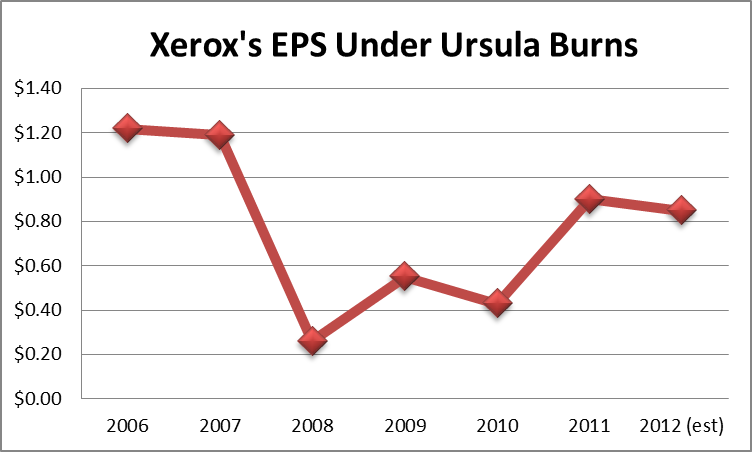
Xerox's CEO Ursula Burns: Ursula Burns has been President or CEO of Xerox since April 2007 and during that time frame, Xerox's stock has registered a negative total return of 57%. Xerox earned $1.22 in reported EPS in 2006, the year before Burns became President. Despite spending over $4.1B in acquisitions and $2.6B on share repurchases, Xerox's Adjusted EPS is expected to be $1.08 and its reported EPS is expected to be $.85 after accounting for acquisition related intangible amortization and restructuring charges. Part of our apprehensiveness with regards to jumping into Xerox alongside Greenlight Capital is that we were concerned that the weak macroeconomic environment was an excuse for poor management and execution issues. We disagree with Oscar Schafer that Ursula Burns is a "tough, no-nonsense CEO" based on the performance of Xerox during her leadership of the company. We believe in calling things as we see them and we think it's appropriate to consider the poor results we have seen under Ursula Burns when evaluating her tenure.

Source: Morningstar Direct and Xerox's Most Recent Guidance
Xerox's Quality of EPS: 2006 was the last year before Ursula Burns was CEO or President and it generated $1.22 in GAAP EPS and $1.05 in Adjusted EPS. 2006 saw its GAAP EPS exceed its adjusted EPS as $500M in Tax Audit Benefits were partially offset by $254M in restructuring charges and $68M in litigation expenses. The company had no adjustments to EPS for FY 2007 and it reported $1.19 in EPS for the year. Unfortunately for Xerox, its EPS from 2008 to present has seen a significant level of adjustments to EPS in each year. 2009 was the year with the lowest level of adjustments ($.15/share) and 2008 was the highest ($.84/share). Of Xerox's $4.90 in EPS from 2008 to 2012, nearly $2/share was clawed back for its never-ending "non-recurring adjustment charges to EPS". 2012 promises to be no different as it will see about $.25 in non-recurring charges for restructuring and amortization of acquisition related intangible assets. At least Xerox's management is only targeting $.15/share in adjustments in 2013 primarily due to amortization of acquisition related intangibles.

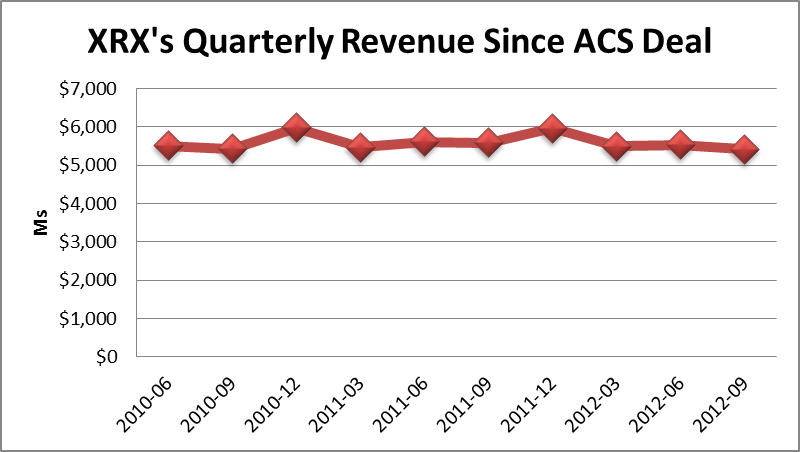
Xerox's Revenue Growth: Xerox's year-over-year revenue growth has never exceeded 3% on a pro forma basis in any quarter since its 2010 acquisition of Affiliated Computer Services. That's not to say that the ACS deal was a deal from hell. In our opinion, we believe that deal was a lifeline for Xerox as ACS's strength in IT Services has offset the weak performance from legacy Xerox operations. Xerox grew its services related revenues by nearly 5% year-over-year in Q3 2012 even though it was faced with significant global macroeconomic headwinds. Unfortunately for Xerox, this was not enough to offset a 10% revenue decline from its products and supplies as well as the associated technical service, support and financing of its products.

Source: Morningstar Direct
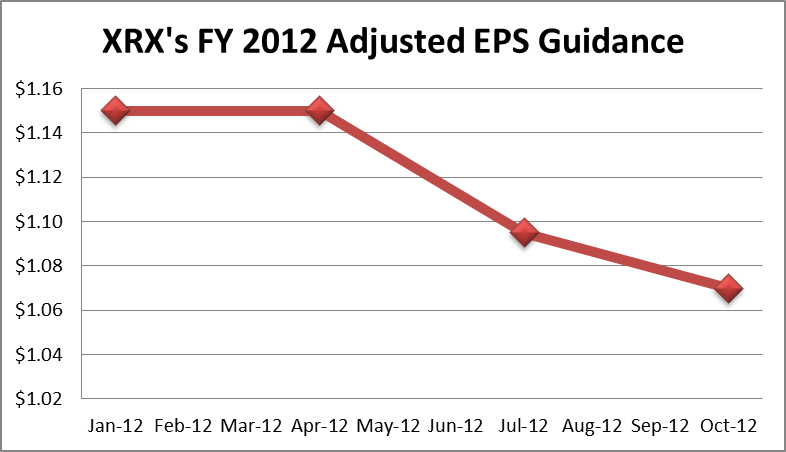
Xerox's Guidance: Even though we have not taken a position in Xerox, we believe that covering the company is comparable to water torture. The reason why we feel this way about Xerox isn't because the stock has gone down by 22% since we began increasing our research resources on it, but because the company has been steadily reporting guidance that has been soft and sour. We think it is becoming a trend on Xerox's part to meet consensus adjusted estimates and to reduce forward guidance and also to announce "non-recurring restructuring charges" that are "excluded from adjusted EPS guidance". At the beginning of 2012, Xerox issued adjusted EPS guidance of $1.12-$1.18. As of its most recent quarter, the company has once again revised its guidance down to a range of $1.07-$1.09, down from $1.07-$1.12 in Q2 2012. Xerox recently announced guidance of $1.09-$1.15 for FY 2013, which was 3% lower than its original guidance for FY 2012.

Source: Xerox's 2012 Earnings Reports

Conclusion
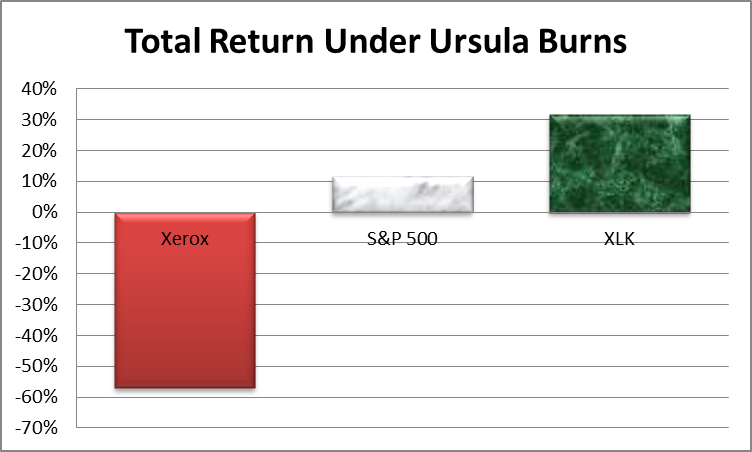
In conclusion, we have taken a fair and balanced approach to analyzing Xerox. We previously evaluated what we liked about Xerox and we have now analyzed what we don't like about Xerox. One thing that Xerox needs to do in order to enable it to unlock shareholder value is replace Ursula Burns with an executive who knows what he or she is doing. Burns has been President or CEO for five going on six years and has been CEO for more than three years. During Burns' tenure as President or CEO of Xerox, the company's shares have declined by 57% while the S&P 500 has recovered its financial crisis losses and generated a total return of 12% during that time. Xerox's 57% negative total return paled in comparison to the 32% positive total return generated by the S&P SPDR Technology ETF (XLK). Although we are pleased to see Xerox make overtures to shareholders by increasing the dividend and share repurchase authorization, we are getting irritated with the sour notes that we've been hearing from management and we question whether Xerox has the right management team to enable it to unlock shareholder value.

Source: Morningstar Direct
Additional disclosure: Additional disclosure: This article was written by an analyst at Saibus Research. Saibus Research has not received compensation directly or indirectly for expressing the recommendation in this article. We have no business relationship with any company whose stock is mentioned in this article. Under no circumstances must this report be considered an offer to buy, sell, subscribe for or trade securities or other instruments.

Friday, November 30, 2012

Who Will Be the Next Hewlett-Packard?

During the technology-stock bubble of the 1990s, it would have been a compliment to say a company had the potential to become the next Hewlett-Packard Co. That same line would have a very different meaning now.

Today, if someone called a company the next Hewlett- Packard, this would probably mean it is a prime candidate to book huge losses because of disastrous acquisitions. What might such a company look like? Consider Xerox Corp. (XRX)

At the start of 2007, Xerox had a stock-market value of $16 billion. Since then, the Norwalk, Connecticut-based printer and copier pioneer has paid about $9.1 billion to acquire 41 other companies. It has destroyed more value than it created. At $6.79 a share, Xerox’s market value is $8.6 billion -- equivalent to 71 percent of its common shareholder equity, or book value.

The most glaring sign that large writedowns may be needed at Xerox is a line on its books called goodwill, which is the intangible asset that a company records when it pays a premium in a takeover. Xerox’s balance sheet would have investors believe that its goodwill alone, at $9 billion, is more valuable than what the market says the whole company is worth.

Xerox’s goodwill obviously isn’t worth that in reality. Goodwill exists only on paper and can’t be sold by itself. It’s a plug number, defined under the accounting rules as the difference between the purchase price for an acquisition and the fair value of the acquired company’s net assets.

‘Reference Points’

Asked about the possible need for large writedowns, a Xerox spokeswoman, Karen Arena, noted that the company will conduct its annual goodwill-impairment test this quarter.
“Share price is just one of several reference points we use to validate our assumptions,” she said. “We also look to our operational results, including cash flows, revenue growth and profit margins.”
Most of the goodwill on Xerox’s balance sheet arose from the company’s $6.5 billion acquisition in 2010 of Affiliated Computer Services Inc., a provider of information-technology services. Xerox allocated $5.1 billion of the purchase price in that deal to goodwill. Xerox’s latest balance sheet also showed $2.9 billion of other intangible assets, the bulk of which are customer relationships acquired from Affiliated Computer.
Suspiciously high goodwill was the same indicator I pointed to in an Oct. 4 blog post suggesting that more large writedowns were needed at Hewlett-Packard. (HPQ) The Palo Alto, California-based maker of computers and printers traded for a significant discount to book value at the time, and its goodwill exceeded its market value by $7.5 billion.

Hewlett-Packard last week disclosed an $8.8 billion writedown of goodwill and other intangible assets from its 2011 purchase of the U.K. software maker Autonomy Corp. It said more than $5 billion of the charge was related to financial-reporting improprieties by Autonomy. The disclosure sent Hewlett-Packard’s shares down 12 percent in a day.

Regardless of whether the allegation proves correct, Hewlett-Packard paid way too much for Autonomy, which had a reputation for aggressive accounting long before it was bought. (Just ask the analysts at the financial-research firm CFRA in New York, who wrote 14 reports from 2001 to 2010 raising doubts about Autonomy’s accounting and disclosure practices.)

Hewlett-Packard had allocated $6.9 billion of its $11 billion purchase price for Autonomy to goodwill. The writedowns disclosed last week were only the latest of their kind. Three months earlier, Hewlett-Packard recorded a $9.2 billion writedown largely related to its buyout of Electronic Data Systems Corp. in 2008.

Dubious Leaders

A search for other companies with strangely high goodwill values turned up several notable examples. Credit Agricole SA (ACA), the French bank that trades for about a third of its book value, shows goodwill of 16.9 billion euros ($21.9 billion). By comparison, its stock-market value is 14.6 billion euros.
Telecom Italia SpA (TIT), which trades for about 60 percent of its book value, has goodwill of 36.8 billion euros and a market capitalization of only 13.2 billion euros. Fiat SpA (F), the Italian automaker, trades for less than half of book and shows goodwill of 10.4 billion euros -- more than twice its market value. Nasdaq OMX Group Inc. trades for 78 percent of book and shows $5.3 billion of goodwill; its market cap is $4 billion.


Those kinds of numbers -- where the balance sheets are clearly out of whack with market sentiments -- don’t necessarily mean the companies will be required to slash asset values. But they are strong indicators that big writedowns may be needed. The test under the rules ultimately comes down to management’s cash-flow projections, and whether they are strong enough to justify the goodwill on the books. That’s why goodwill writedowns can be an important signal about the future.
Xerox had an infamous accounting scandal more than a decade ago that resulted in a $10 million fine by the Securities and Exchange Commission. The penalty was a record at the time for an accounting-fraud case. Six former executives, including former Chief Executive Officer Paul Allaire, paid $22 million in SEC settlements in 2003. The last thing Xerox and its CEO, Ursula Burns, should be giving investors is a reason to wonder whether they can trust the company’s numbers.

The market has already decided it has one.

Tuesday, August 7, 2012

HP Sails Into Perfect Storm for Printers

It’s not hard to see evidence of that wider trend in the results of several companies in the printer and printer supplies business. In a research note out today, analyst Chris Whitmore of Deutsche Bank Securities looked at sales trends over the last 10 quarters at printer companies including Canon, Epson, Lexmark, Xerox and Hewlett-Packard and found that combined sales for equipment and supplies were down 6 percent year on year.

Additionally, sales of printing equipment during the last year have declined similarly, which is a bad sign for sales of supplies as they tend to lag sales of hardware by nine to 12 months and are more often than not the profit-making end of the business. Another indicator, sales of printer paper (specifically A3 and A4 paper) fell 6 percent in the second quarter to levels that are 20 percent below their historical peak in 2006.

Whitmore’s conclusion: The use of printed pages is on what appears to be a permanent decline that could only accelerate as tablets like the iPad and others like it get more popular. “Simply put, the content that was once printed for distribution or portability is now simply being distributed or shared electronically,” he writes.

All of the companies in Whitmore’s survey have already reported their earnings this quarter, except for one: Hewlett-Packard, and it reports its quarterly results on Aug. 22. When we last heard from HP, revenues in its imaging and printing group had decreased by nearly 9 percent, or more than $1 billion, for the six-month period ending April 30, down to $12.4 billion. Leading that decline was a 6 percent drop in sales of supplies, which may not seem important until you realize that sales of supplies have historically amounted to about $17 billion a year, or more than two-thirds of HP’s $25.7 billion revenue in the printer business.

It’s not the first time this trend has been so apparent: HP’s printer fortunes looked very stormy indeed ahead of another earnings report earlier this year.

This decline was at least one of the reasons that HP CEO Meg Whitman combined the company’s printer business unit with the personal computer unit under Executive Vice President Todd Bradley. Selling printers and PCs together, the thinking goes, creates an opportunity to save on costs that are otherwise duplicated.

But there may be other more fundamental changes coming to the way the printer business operates. In an interview with AllThingsD in June, Bradley hinted at such changes, especially around ink products, and indicated the company might reconsider cutting some money-losing printer models on the low end.

No one expects HP’s quarterly results to be particularly good. In fact, the consensus view of analysts surveyed by Thomson Financial calls for it to report overall sales that declined by about 3 percent year on year.

And the future doesn’t look any brighter, especially as the decline in printing extends into the workplace. Companies like Xerox and Lexmark have tried to minimize the damage by turning printing into part of a wider document and work-flow management service. But these services may fall victim to tightening corporate IT budgets. As Whitmore puts it: “From an enterprise standpoint, printing is increasingly a cost to be managed lower rather than area of spend or investment. Although many enterprise print vendors are competing via managed print services engagements, this trend speaks to the discretionary nature of spending on printing. As such, we suspect it will be the most vulnerable to future spending cuts.”